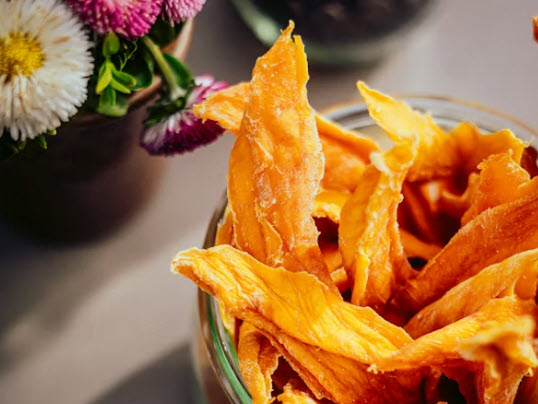
Fresh mango does not tincture well. The water content is too high (80%+) and the sugars ferment unpredictably. For clean extraction, use freeze-dried mango or mango puree reduced to a thick paste. Macerate in 40-50% ethanol for 72-96 hours.
The volatile fraction is delicate. Delta-3-carene and myrcene are the dominant terpenes, but they oxidize quickly. Work in closed vessels, minimize headspace, and keep extraction temperatures below room temperature if possible. Heat destroys the fresh-mango character rapidly.
An alternative approach: mango pit (seed kernel) tincture. The kernel contains a concentrated terpene and phenolic profile closer to mango skin than flesh. It extracts cleanly in ethanol and produces a more stable, less sugar-dependent mango character. Bitter and astringent, but recognizably mango.
Intensely tropical. Pine-resinous (carene, myrcene), sweet-fruity (esters), and creamy-coconut (lactones). The combination is unmistakable. Ripe mango pushes the ester and lactone fractions forward; green mango emphasizes the terpenes.
Sweet, tropical, with a resinous pine quality that becomes apparent when the sugar is removed. The terpene backbone is surprisingly assertive. Green mango has notable tartness from citric and malic acid.
Full and coating from natural sugars and pectins. Freeze-dried or extracted mango is lighter. The lactone fraction contributes a creamy quality even in the absence of actual dairy or fat.
Medium. The ester-driven fruity notes fade first. The terpene backbone (carene, myrcene) persists longer, leaving a subtle piney, resinous tail. The lactone creaminess lingers.
Mango tincture in a whiskey sour. The shared terpene language between mango's myrcene and whiskey's oak-derived compounds creates unexpected continuity. Carene adds a piney brightness that lifts the drink.
Small amounts of mango tincture in tropical bitters formulations. The lactone fraction adds a creamy, coconut-adjacent note that rounds out sharper citrus and spice components.
The most abundant terpene in many mango cultivars. Sweet, piney, resinous. Also found in rosemary and pine. Responsible for mango's unexpected resinous quality.
Herbal, slightly fruity monoterpene shared with hops and cannabis. Contributes to mango's 'green' aromatic quality. The biosynthetic link to other myrcene-rich plants.
Creamy, coconut-like lactone contributing to mango's rich, tropical smoothness. Part of the ester-lactone fraction that defines ripe mango character.
Citrus brightness in the top note. Less dominant than in citrus fruits but contributes to mango's complex, multi-layered terpene signature.
Fruity, pineapple-like ester contributing to the tropical fruit impression. Part of the volatile ester complex that distinguishes ripe mango from green.
Fresh, piney, slightly floral. A minor but characterful terpene that adds complexity to mango's aromatic top note. Also found in tea tree and nutmeg.
Ginger's gingerol heat and mango's terpene-rich tropical character are a classic tropical pairing. The shared myrcene content creates aromatic overlap beneath the obvious contrast.
Cardamom's cineole coolness provides contrast to mango's warm, resinous terpenes. The combination appears in South Asian lassi and dessert traditions for good reason.
Elderflower's linalool and rose oxide provide floral complexity that elevates mango's fruitiness. The pairing moves mango from tropical-sweet to tropical-aromatic.
Strip the sugar from mango and what remains is a terpene profile closer to hops and cannabis than to peach or pineapple. Delta-3-carene and myrcene dominate, with a lactone undercurrent that provides the creamy tropical impression. For formulation, this means mango's real utility is not as a fruit flavor but as a terpene source with built-in creaminess. Use it where you need pine-resinous tropical character without relying on sugar to carry the load.